
Lately, we increasingly hear the same frustration from business owners and content creators: the content they publish has simply stopped working the way it used to before the era of AI slop. Regular posts, the newest tools supporting publication consistency, and yet nothing seems to come of it. Engagement is essentially standing still, website traffic is starting to drop despite all the hard work, and the sense of connection with the audience is fading away.
The first signals appeared as a clear drop in clicks for content on YouTube and Google. Initially, this could be blamed on a seasonal slump (the study was conducted in May 2026) or a natural stagnation related to the approaching summer holidays. However, after talking with other entrepreneurs, it became clear that this experience is very widespread. The drop in engagement is being observed even by those who have built a strong, loyal audience over the years.
In the article below, we will examine the most important questions associated with this: is everything we see online today truly created by AI, what exactly is the phenomenon of "AI slop," and how can you rebuild your community and successfully stand out in search results?
Common problem: The "Sea of sameness"
Every industry is reporting the exact same issue: content marketing is spinning faster than ever, yet the results are getting weaker. This is not an isolated incident. We are all currently dealing with a massive shift in how audiences consume content in 2026, and no, it is not just about Gen Z's attention span.
You only need to set a YouTube alert for "AI fatigue" to see a constant stream of new videos addressing this exact topic. The sheer volume of content describing this problem confirms that people are genuinely struggling with it. In conversations with friends and colleagues, it is hard to miss, as discussions invariably revolve around a single subject: artificial intelligence.
Therefore, this problem goes far beyond:
-
publication frequency,
-
keyword selection, meaning SEO,
-
or minor changes in social media algorithms.
The core of the issue is the AI trap. Because artificial intelligence allows reasonably high-quality, grammatically correct content to be generated in seconds, the internet has been flooded with a wave of "average-perfect" material. And when everything sounds the same, audiences stop paying attention to anyone.
You only have to scroll through Instagram or YouTube to notice how much of what appears there clearly looks like it was generated by AI. It is visible in the wave of books published in 2026, accompanied by reviews that sound like pure "AI slop." You can also see it in the comment sections under videos and in industry articles that lack any unique, human perspective.
What is AI slop?
Since we mentioned "AI slop", what exactly is this phenomenon? It is a term that has settled into internet slang to describe content (texts, images, videos) created en masse by AI, without human editing, a sense of quality, or care for the audience. It is characterized by superficiality, repetitiveness, and a lack of real value, as the content exists simply to exist and fill space rather than to actually help or teach someone something.


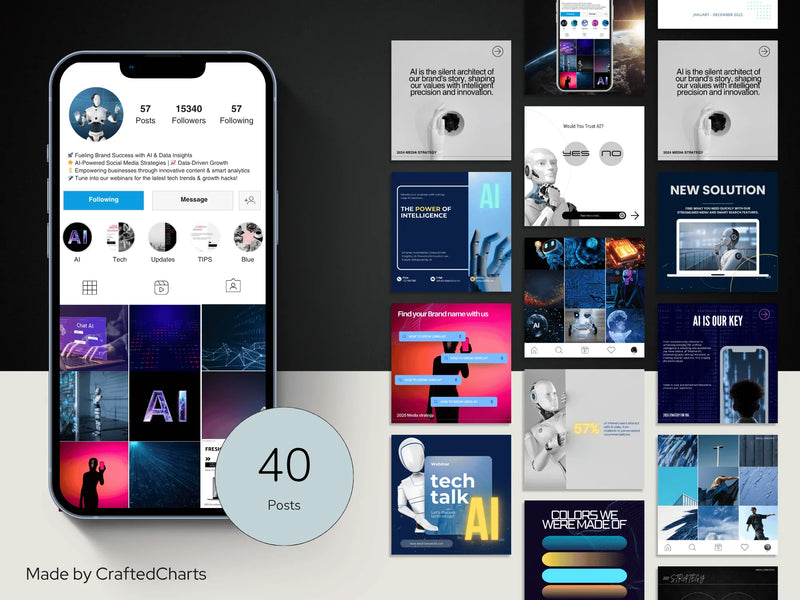
Is everything created by AI today?
This impression is backed up by numbers. An Ahrefs study that analyzed nearly one million new websites from April 2025 showed that 74.2% of them contained AI-generated content. It is worth adding an important detail: only 2.5% were pure AI with no human intervention, while the rest were a mix of human and machine work. The situation is similar with images, as up to 79% of pictures on Instagram, TikTok, and Pinterest show traces of AI.
Source: https://ahrefs.com/blog
What happens next is particularly interesting. Despite this flood, quality still wins: only 14% of articles that actually rank high on Google are fully AI-generated. The internet is flooded with mass production, but that's not what lands at the top of search results. Is 14% a lot? Hard to say. But if your competitor happens to be sitting inside that 14%, then yes, it's a lot, because it means they're already winning with AI-generated content.
Is AI slop slowing down?
Quite the opposite. We are producing more content today than ever before. The problem is that audience engagement is completely failing to keep up with that pace.
The numbers clearly show this disconnect. Average engagement per post is dropping on almost every major platform; comments on content dropped by 24% on TikTok and 16% on Instagram year over year, showing a shift from active engagement to passive scrolling. Even Instagram, which was solid in its results not long ago, saw average engagement drop from 2.94% in January 2024 to around 0.5% just a year later.
Why your content feels like it "disappeared"?
It is not that platforms have "punished" you, but rather that the barrier to entry for average content has dropped to zero. Ever since AI entered the game, the web has been flooded with the mentioned AI slop, which is not slowing down, if anything, it is accelerating. To stand out, you must do what AI cannot: show a distinct, authentically lived perspective.
We already know you are dealing with a drop in engagement. The question is: what can you do about it to regain your audience's attention? Let us start by understanding where this drop comes from, because only by knowing the cause can you save your content.
The drop in engagement stems from a few specific reasons:
-
AI content is too predictable. Human writing has a natural rhythm: a mix of short, punchy sentences and longer, more complex ones. AI sticks to a single, even tempo, which the reader's brain instantly recognizes as automated, in other words, there is no mystery left to uncover.
-
AI is trained to be helpful and safe, so it avoids saying anything controversial or raw. Customers are specifically looking for what is "real": mistakes, opinions not everyone agrees with, and specific, imperfect details of everyday work. Content that says "an entrepreneur should" loses the reader. But content that says "when we were working with a client and realized that [specific problem]" hooks them.
Will human content beat AI?
More and more data indicates that this does not have to be a competition between one or the other. The greatest breakthrough power comes from mixed content. AI saves a massive amount of time on research, structure, or the first draft, while a human adds a perspective that AI simply cannot copy.
It is worth remembering what AI actually is. It is an algorithm relying on a limited database, and although it can give the impression of an all-knowing machine, at its core it is merely a more advanced search engine that knows how to piece words together better than others.
How to stand out when everyone writes with AI
The situation is still quite unusual: the market is only just learning to live with it, and AI tools are changing fast enough that it is hard to speak of a single, established method of operation. Still, it is not worth sitting on your hands waiting for everything to sort itself out on its own. Instead of adding to the flood of generic content, it is better to consciously decide how to use AI.
A few specific rules worth implementing in your content work:
-
Sketch out your main ideas yourself first, then use AI to expand, organize, or research. What originates from you remains the heart of the text.
-
Add something AI could not possibly know. A specific story, a name, a date, a place, a number, anything that anchors the text in experience rather than generalities.
-
Define your "voice" in three words (e.g., "direct, warm, no-nonsense") and instruct AI tools to avoid corporate jargon and clichéd lists of "three points."
-
Read the text out loud. If you stumble anywhere, it is a sign that the passage sounds too mechanical. Rewrite it so it sounds like a face-to-face conversation.
Do not give up on AI; quite the contrary, consciously keep it in the role of a tool. But never as the author!
Win with the AI slop in 2026
It is not about ignoring technology, but about using it skillfully. We are in a transitional period where "quantity" has ceased to be a measure of success; now, what matters is whether the text actually reaches someone.
If engagement is dropping, do not publish more. Publish deeper. Share stories that seemed "too personal" or "too specific", these are the exact things that will make you stand out in a market flooded with AI content.
The initial instinct is often different: "since everyone is publishing more, I have to as well." And thus a vicious circle closes: instead of cutting through the noise, we only amplify it by adding another portion of content that no one has the time or desire for.


