Een coachingbedrijf runnen

De meeste coaches raken niet opgebrand door het coachen zelf, maar door veel diepere oorzaken: ze raken opgebrand door het dragen van de emotionele last van hun cliënten, het niet stellen van gezonde grenzen, de voortdurende behoefte om hun waarde te bewijzen en de druk van de markt. Werken in dit beroep vereist enorme reserves aan diepe empathie, wat zonder voldoende herstel vanzelf leidt tot uitputting en verlies van betrokkenheid.

Daar komen alle logistiek en het zogenoemde onzichtbare werk nog bij: de lange uren die buiten de daadwerkelijke cliëntsessies worden besteed. Dit is al het voorbereidende werk, waaronder zorgvuldige voorbereiding van gesprekken, permanente educatie, supervisie en materiaalanalyses, maar ook het najagen van contracten, het helemaal opnieuw uitschrijven van sessienotities, het inschatten van tarieven of het bijhouden van betalingen. Voor geen van deze dingen hoef je meer uren te maken; je hebt simpelweg betere hulpmiddelen nodig om de belasting voor je geest te verminderen.

Deze gids behandelt de gebieden die bepalen hoe een coachingbedrijf dagelijks daadwerkelijk draait: het onboarden van cliënten, de sessiestructuur, bedrijfsplanning en planning. Bij elke stap hebben we sjablonen uit de collectie van CraftedCharts gelinkt.

Start every client relationship with a clear onboarding process

The first weeks with a new client set the tone for the entire relationship. Implementing a repeatable starting procedure, including gathering a detailed brief, sharing introductory materials, and holding an initial kick-off call: saves time, reduces a flood of questions, and builds full trust from day one.

Any unclear expectations at this stage regarding scope, communication, payment, or the very essence of coaching tend to resurface later. A solid onboarding process nips this in the bud before it even arises.

Client Onboarding Template & Welcome Pack handles this end to end, so you're not rebuilding a welcome packet for every new client.

Give every session a consistent structure

Professional coaching requires a proper welcome at the beginning or closing the meeting with a concrete action plan. This stable foundation is what so-called intentional improvisation relies on: you move away from a rigid script in order to flexibly follow whatever is happening "here and now" with the client.

Improvising without any base only works for a while until you can't remember what you discussed last time, or a client asks about a commitment from three weeks ago. A consistent session structure (goals, notes, tasks, and summary) turns every meeting into a real working tool, rather than just a conversation where you rely on memory.

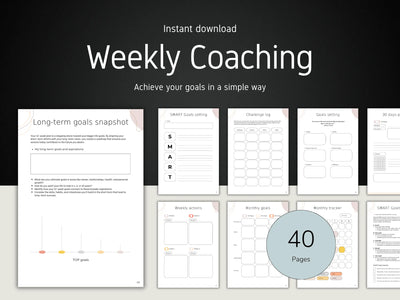
Structured Weekly Coaching Program for Life Coaches provides a ready-made plan so that each session naturally builds on the previous one.

Build a business plan you'll actually use

A lot of coaches skip business planning entirely, or write one once and never look at it again. The useful version is shorter than people expect: your positioning, your offer, your pricing logic, and a rough plan for getting clients, kept somewhere you'll actually revisit.

Coaching Business Plan Template is built specifically for coaching businesses, not adapted from a generic startup template.

Keep your schedule and materials in one place

Between session notes, client materials, social content, and documents, most coaches end up with files scattered across five different tools. Keeping your core materials in one editable, on-brand format saves the time you'd otherwise spend recreating things or hunting for the right version.

Canva Templates Bundle rounds this out with ready-to-edit materials you can adapt as your coaching business grows.

Frequently asked questions

How much should I charge as a coach?

Pricing depends on your niche, experience, and format (1:1 vs. group), but most coaches price around either a per-session rate or a package rate for a set number of sessions. A business plan template can help you work through your pricing logic rather than guessing.

What should be included in a coaching contract or onboarding pack?

At minimum: your services, session cadence, cancellation policy,payment terms, and confidentiality expectations, all part ofthe ethical practice standards professional coaching bodies like the ICF outline.

How many sessions should a coaching program include?

This varies widely by niche, but many structured programs run in blocks of 6-12 weeks, giving enough time to see measurable progress without an open-ended commitment.

Eenvoudige en slimme Google Spreadsheets-sjablonen | Premiumbibliotheek
Simple & Smart Google Sheets Templates | Premium Library

Eenvoudige en slimme Google Spreadsheets-sjablonen | Premiumbibliotheek

Simpele en stijlvolle Canva-sjablonen | Premiumbibliotheek
Simple & Aesthetic Canva Templates | Premium Library

Simpele en stijlvolle Canva-sjablonen | Premiumbibliotheek

Professionele en strategische bedrijfssjablonen | Premiumbibliotheek
Professional & Strategic Business Templates | Premium Library

Professionele en strategische bedrijfssjablonen | Premiumbibliotheek

Expert- en analytische SEO-sjablonen | Premiumbibliotheek
Expert & Analytical SEO Templates | Premium Library

Expert- en analytische SEO-sjablonen | Premiumbibliotheek

Virale en strategische Instagram-postsjablonen | Premiumbibliotheek
Viral & Strategic Instagram Post Templates | Premium Library

Virale en strategische Instagram-postsjablonen | Premiumbibliotheek

Creatieve en sociale spelsjablonen | Premiumbibliotheek
Creative & Social Game Templates | Premium Library

Creatieve en sociale spelsjablonen | Premiumbibliotheek