Why most coaches never build a thriving business
Coach training teaches you how to coach: how to ask better questions, hold space, and guide someone toward their own answers. What it almost never teaches is how to build a business around that skill. Client acquisition, pricing, positioning, and sales are treated as an afterthought, if they're covered at all.
That gap shows up in the numbers. Industry estimates commonly cited across the coaching space suggest that the large majority of new coaching businesses fail within their first two years, not because the coaches lack ability, but because they finish certification believing that being good at coaching is enough to attract paying clients. It isn't. In a market with more than 120,000 practicing coaches worldwide, that gap becomes even more costly: a great coach with no way to reach clients simply disappears into the noise.
The coaches who do build lasting businesses treat marketing and sales as a second skill set worth mastering, just as learnable as coaching itself, even though it's rarely taught in the same classroom.
Break the fear and build your confidence
Before any of the practical steps like the business plan, the pricing, the website, you'll run into a much simpler barrier that stops most people from ever starting: fear. Fear is often just a story your mind tells you about what could go wrong, dressed up to look like fact.
The same goes for believing you're "not a business person" or "bad at marketing." That's rarely a fixed truth; it's usually just a skill you haven't practiced yet. The moment "I can't do this" becomes "I can't do this yet," the whole thing stops feeling like a wall and starts feeling like a learning curve.
If some part of you is still questioning whether coaching is the right path, that's worth listening to but it's rarely a good reason to quit before you've actually tried. A few small, repeated habits tend to make the biggest difference in how confident you feel taking that first step:
- Morning affirmations
- A daily meditation practice
- Deliberately collecting small wins
- A nightly gratitude note
- Regular coaching or mentoring for yourself
None of these make the fear disappear overnight. What they do is build the kind of quiet, repeated evidence that makes each next step easier than the last one.
Step 1: Define your vision, mission and values
If you've already decided to turn coaching into a real business but still feel a bit lost on where to start, this is it: get clear on your vision, mission, and values.
A vague line like "I want to help people grow" won't help you make a single real decision. You need actual clarity, who exactly you help, what specific problem they're dealing with, and what changes for them once they get there. That clarity is what shapes your niche, your offer, and eventually your pricing, so it's worth nailing down now instead of circling it in your head for months.
If you'd rather work from a ready-made structure built specifically for coaches, the Coaching Business Plan Template gives you the prompts and sections to get your vision, mission, and values down on paper in an afternoon.
Step 2: Set your financial goals
Write down what you actually want to earn, then compare it to what your current rates and client capacity can realistically bring in. This step is often the first real gut-check. For a lot of new coaches, those two numbers don't match at all. It tells you whether you need higher rates, more clients, or another income stream alongside 1:1 coaching, like speaking or corporate work.
Earnings vary widely by niche, experience, and format, so it's worth grounding your target in real numbers, we cover this in more depth in What is a life coach salary in 2026.
Legal and financial foundations
Once your vision and numbers are in place, it's time to make things official. Every country handles this differently, but the core pieces are usually the same:
- Choose a business structure. Most new coaches start as a sole trader/self-employed individual because it's fast and inexpensive to set up, though a registered company can make more sense as income or liability grows.
- Open a separate business bank account. Even before real revenue starts coming in, keeping coaching money apart from personal money saves you headaches later.
- Get professional indemnity insurance. It covers you if a client ever claims your coaching caused them harm or financial loss, and it's relatively inexpensive to start with.
Exact requirements, costs, and paperwork vary a lot from country to country, so treat this as a checklist of what to look into rather than exactly how, this isn't legal or tax advice, and a short conversation with a local accountant or business advisor before you register anything is worth the hour.
Find a niche the market backs
You won't find your niche by sitting alone theorizing about it, you'll find it by talking to people. Reach out to your existing network, have a few informal conversations, run a short survey, or just pay attention to what the people around you complain about. Real market research beats guesswork every time, and it keeps your niche grounded in actual demand rather than in whatever sounds interesting to you on paper.
Keep one thing in mind: nobody pays for "coaching" as an abstract concept. People pay to solve a specific problem, get promoted, fix a broken habit, stop procrastinating, rebuild confidence after a setback. Coaches who struggle to land clients are usually still describing what they do in generic terms ("I help people grow"). The ones with full calendars can name the exact situation their ideal client is stuck in, in the client's own words. Your niche doesn't have to be permanent, most coaches sharpen it as they gain experience but it does need to be specific enough that a stranger recognizes themselves in it immediately.
That said, it's worth following what genuinely interests you and what you're actually good at, just pair it with some common sense. Pick a niche that fascinates only you, with no real demand behind it, and you'll quickly run into an empty calendar and the frustration that comes with it. The strongest coaching businesses sit at the intersection of what you're genuinely drawn to and a real problem people are already willing to pay to solve.
Create an offer and the materials to show it off
Coaching is intangible, which makes it genuinely hard to sell. Nobody can "see" six sessions before they buy them. The fix is turning that intangible process into a tangible package: a named program, a clear timeline, and a specific outcome the client can picture before they ever get on a call with you.
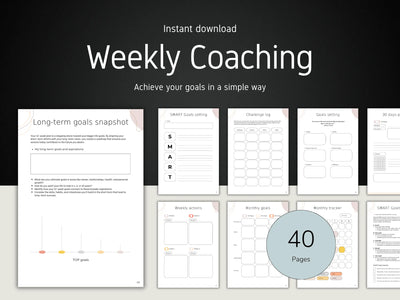
Once the offer itself is defined, you need materials that present it well, a one-page overview to send to prospects, a few social posts explaining what you do, a simple proposal or welcome document. Structured tools inside your actual coaching practice earn their keep here too: giving a client a 30-60-90 Days Challenge Template or a 12-Week Goal Planner to work through between sessions makes the transformation visible.
The bottom line
The coaches who actually make it aren't the ones with the best certification or the cleverest niche. They're the ones who stopped waiting to feel ready and started treating this like the business it actually is: something you build, test, and adjust, month after month.
If you want the short version to come back to:
- Deal with the fear first - not by eliminating it, but by acting anyway, in steps small enough that "I can't" turns into "not yet."
- Get specific about who you help - a vague mission helps no one, including you.
- Run the numbers before you run the business - what you want to earn and what your current rates can actually produce are two different things.
- Handle the paperwork once, properly - business structure, a separate bank account, insurance.
- Find a niche people already pay for - not the one that sounds best on paper, the one you've confirmed by talking to real people.
- Package what you do - turn coaching sessions into something a stranger can understand and buy in under a minute.
There's no perfect moment to start this. There's just the version of you that begins with what you have now, and the version that keeps waiting for a plan that feels complete. Pick the first one.