
Build a winning strategy for your business, step by step
If you're sitting at your desk right now, head full of ideas and a vision of a great business you just can't seem to put on paper — or worse, everything is piling up so fast you can't tell where it starts and where it ends — rest assured, you're not alone. New businesses are born almost every day, with or without a marketing plan, and that single choice can end up deciding how the company fares down the road.
A marketing plan is the second most important document a business can have, right after the business plan. A solid business plan lays out all the essential details: what the company actually is, what it does, how it intends to succeed, who the competition is, and who the ideal customer looks like. A marketing plan, on the other hand, defines "how" the company will reach its audience, build lasting relationships with them, and convince them to buy what it's selling.
In other words: the business plan answers "what" we're offering, "why" it makes sense, and "for how much"; the marketing plan focuses on "how" to win a customer and keep them.
Does every business need a marketing plan?
Of course not but having one certainly helps. In CraftedCharts' early days, we spent countless hours working with entrepreneurs, helping them organize their ideas and set business goals for the years ahead. What we noticed again and again was that most people had an incredible vision and a genuinely positive attitude toward growth, but hit a wall the moment they had to translate that vision into a structured document. Why? Simply put, most people have never built a marketing plan before, and don't know what should go into one or which questions each page is supposed to answer.
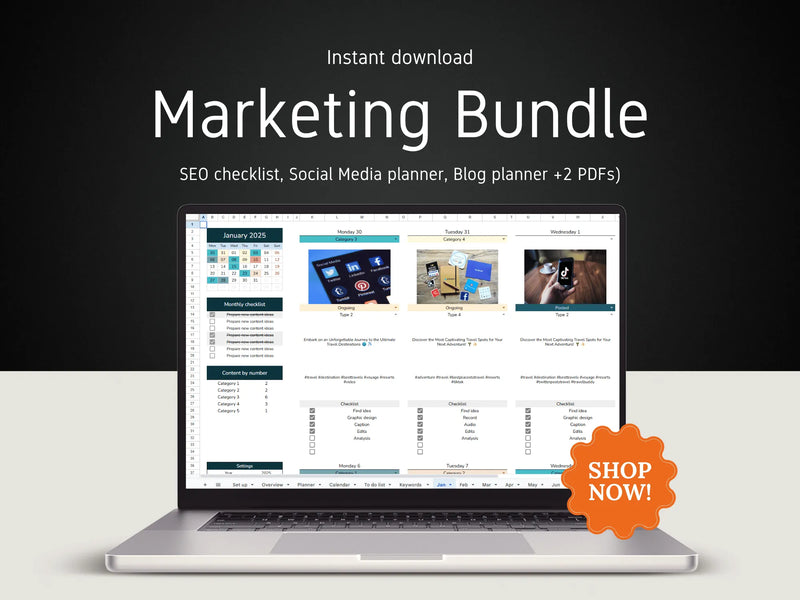


Below, we walk through one of our ready-made marketing plan templates: its key components, what it's built from, and what each section is responsible for.
What exactly is a marketing plan?
As mentioned above, it's a document that outlines a company's actions, how you'll bring your product to market and reach your target audience. A good plan brings together what you believe in as a brand, what you have to offer, and where you want your sales to go. This kind of document shouldn't rest on a rosy outlook and wishful thinking ("I want to sell as much as possible"), but on hard data, market analysis, and a clearly defined customer persona — more on that below.
Should a marketing plan be long?
No, although that depends on what you want to include and how detailed you need it to be. Keep in mind that the more data you cram in, the less readable and more tedious the document becomes. The goal of a marketing plan is to present all the key points clearly. It's not meant to be a massive academic report, but a living description of your actions, one that immediately shows whether you're leaning into inbound or outbound strategies, how your customer behaves, what their LTV is, and exactly what will generate profit for the business.
Build your own marketing plan
Below, we show how to structure a marketing plan based on our own template — a 58-page plan covering every element needed for a proper market analysis. This template was built through work with entrepreneurs in the e-commerce and fashion industries between 2025 and 2026, and was last updated in June 2026.
What to include in a marketing plan
There's no single, universal answer to what a marketing plan should contain, since every plan needs to be tailored to the business's unique goals, industry, and stage of growth. A company selling croissants that's just entering the market won't prioritize the same sections as an established company that transports priceless works of art.
That said, the overall outline tends to follow the same core structure, it's the emphasis, and which elements take priority, that shifts from business to business.
Below is the structure of a marketing plan based on the CraftedCharts template, designed to answer the most important questions while still fitting a wide range of businesses. It isn't built around any single industry profile. You can use it as-is, or treat it as a foundation and build your own plan tailored precisely to your needs.
Table of contents:
- Company information
- Overview, mission & vision statement
- Goals & objectives
- Company description
- Business model
- Product & market analysis
- Product/service offered
- Market position & analysis
- Industry overview
- Market trends
- Marketing strategy & planning
- Marketing objectives
- Sales strategy & production plan
- Budget planning
- Development plan
- Financial planning
- Financial plan & budget
- Financial projections
- Extras
- SWOT analysis
- Competitor analysis
- SEO steps
What are the 5 steps to creating a marketing plan?
The most common approach breaks the process down into five key stages: analyzing the current situation, defining the target audience, setting clear goals, choosing a strategy, and measuring results.
Our marketing plan template follows exactly this approach. The opening pages focus on presenting the company and analyzing its current position, before smoothly moving into audience analysis and goal-setting. The next step is selecting and implementing the best marketing strategy, and precisely defined KPIs let you track results in both the short and long term as you go.
The start of a marketing plan — company overview
Every marketing plan should begin with a company profile. These core elements are the most natural starting point for most businesses, they're the easiest to define, and they lay the groundwork for everything that follows.
This section should include:
- Mission and vision — a short statement of why the company exists and what drives it
- Goals and objectives
- Company description and history — not a strictly required element, but one that lets you highlight what sets the brand apart
- Business model — how the company delivers value and turns ideas into revenue
Each of these elements deserves its own dedicated page.
Product and market analysis in a marketing plan
Unlike the previous section, which can read like a straightforward description, this part demands deeper analysis. You need to clearly show what you're selling and where you stand in the market over the long term. Surprisingly, most companies skip a formal competitor analysis until they're already deeply established in the market — a big mistake. Analyzing rivals early is the simplest way to sharpen your own product positioning and avoid the market's most common pitfalls.
This section should present:
- Products and services — highlighting the features, benefits, and unique value that set you apart from the competition
- Market position, both current and future — this is a market-focused SWOT analysis that shows how you plan to stand out among existing players and any that might enter the market
- Industry overview and trends throughout the year
- Market opportunities — pinpointing the gaps you can fill and the areas where the business can grow
Importantly, the product and market analysis section shouldn't list every single product your company offers in detail. The plan should be built around your core assumptions and flagship products — the ones driving the business forward. The goal of the document is to showcase potential, not to serve as a lengthy sales catalog listing every product variant. The same goes for services.
Marketing and sales strategy
This is often the longest section of the plan, and for good reason. This is where you lay out how customers will hear about your brand, which sales channels you'll use, and how you plan to show up.
The following pages of the marketing plan go into detail on the key customer-outreach activities, the sales channels you've chosen, and your objectives. Those objectives should be split into short-term and long-term goals, so you can regularly check off KPIs, track progress, and adjust course as needed.
This section also needs to cover your content or ad production plan — how often things go live, exactly where they land, and who they're aimed at.
Another key element is the budget. You can break it down in full, but be careful not to get lost in the weeds — if you itemize every single dollar, your marketing plan turns into a financial spreadsheet, which isn't the point. The budget should summarize the main spending categories at a glance (think "Google Ads," not the names of dozens of individual campaigns).
Finally, we move on to the development plan — your strategy for the coming months or years. Here, you spell out exactly what you want to achieve, set your key milestones, and honestly name the risks — both external threats and internal limitations. A good plan should openly acknowledge your blind spots and weak points. This development section lets you step back and look at the business from a wider angle, evaluate current activity, and confront the fundamental question: are we actually doing this right?
Financial planning and budget in a marketing plan
You can lay out the budget as its own dedicated section, or fold it briefly into the marketing strategy section, as mentioned earlier. The budget is a summary of both revenue and expenses, giving you full visibility into the company's overall cash flow. Here too, there's no need to dive into microscopic detail — just present the key figures clearly enough that a quick glance at the page shows what percentage of the business each item represents. For example: content generation costs $600 a month, but generates roughly $12,000 in returns — about 30% of the business.
Ideally, your financial forecast should account for several growth scenarios, including the worst-case ones, this is what allows you to effectively manage the risks that come with running a business.
Why use a ready-made marketing plan template?
It depends, not every template will be a perfect fit for your needs, so the key is choosing one that covers everything that matters most to you. A well-built plan should walk you step by step through presenting your company, defining your audience profile, analyzing the market, laying out your marketing strategy, covering your finances, and outlining your growth plans. Using a ready-made template is, above all, a massive time-saver. You skip the work of designing the document's structure.


