
Take care of your Shopify store and reach the widest possible audience.
Setting up a store is only the beginning. The real challenge starts when you need to reach customers. While paid ads consume your budget from day one, SEO becomes a crucial channel for organic traffic, allowing you to acquire buyers directly from Google search results.
Most stores do not suffer from a lack of strategy; they suffer from a lack of clarity. SEO is not about doing everything at once, but about consistently implementing actions with the highest impact on sales. After all, you can rank #1 on Google for a popular phrase and not earn a single cent, or you can position yourself for the right keywords and generate orders every day.
Below you will find a concrete set of improvements for your Shopify store that will step by step allow you to squeeze the maximum SEO potential out of product pages, collection pages, and your blog.
First of all, why is SEO so important on Shopify?
Growing your own Shopify store differs from selling on platforms like Etsy or Gumroad. There is no ready-made buyer base or internal marketplace search engine here. You have to take care of every single unique visitor yourself. Without investing in SEO, your store remains an invisible island on the web, forcing you to constantly pay for ads.
Can I manage SEO on Shopify on my own?
It depends on your level of knowledge, free time, and enthusiasm for the work.
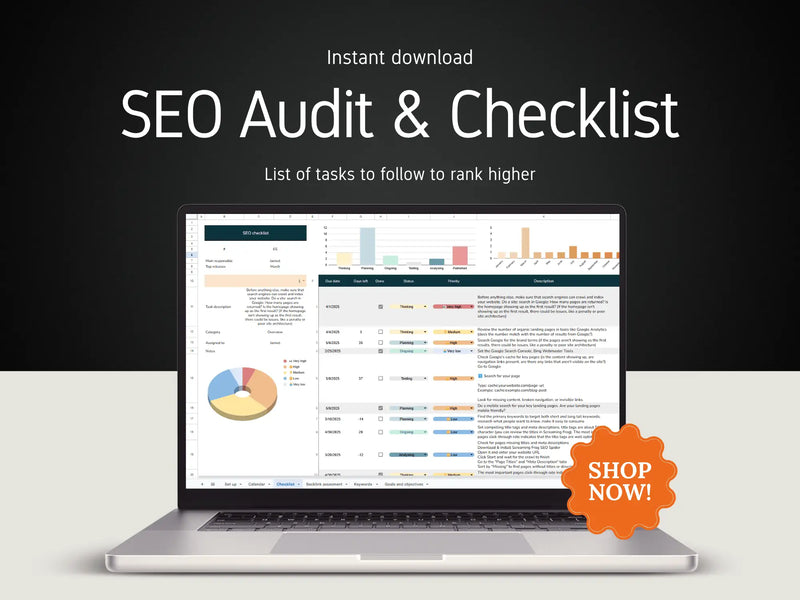
Even someone without technical experience can effectively boost their store's visibility, provided they prepare properly and follow a proven process. To get started, helpful tools like our SEO Checklist Template can guide you step by step through the most important tasks. However, for more complex topics, it is worth considering collaboration with SEO experts who specialize in Shopify (for example, by hiring a specialist through platforms like Upwork).

If you decide to handle everything entirely on your own, you must be aware of the risks, as changes made without proper preparation can bring counterproductive results. Many technical improvements can be complicated, and an ill-considered modification to the theme code or URL structure can lead to drops in rankings, indexing errors, and in extreme cases, even incorrect display of the entire website. Check out more information on how to stop fraud orders on Shopify.
Shopify SEO basics: Where to start optimizing
Many Shopify stores struggle with ranking not due to a lack of advanced technical knowledge, but simply because they do not know where to start and how to set priorities.

To begin with, it is worth appreciating the platform itself. Shopify, like any solution, has its pros and cons, but its built-in SEO management is quite solid. The system automatically handles most technical foundations: it generates clean URL structures, provides default meta fields, and offers an index-ready site structure along with an XML sitemap. Thanks to this, instead of wasting time on complex server configurations, you can focus from day one on what brings the highest return: optimizing content and building visibility.
For optimization to bring a real boost in sales, you need to keep two key rules in mind:
-
SEO goes beyond product pages: Enormous potential lies in collection pages, the homepage, and blog posts. Category pages and guides often attract the highest volume of traffic with strong purchasing intent.
-
A two-pronged approach (On-Page & Off-Page): Optimizing the website itself is only half the battle; its reputation in the eyes of Google, built through a strong backlink profile, is equally vital.
Shopify SEO Guide
Below is a checklist backed by 3 years of Shopify experience that you can implement right away to streamline the most critical SEO elements in your store.
However, if you are looking for a more comprehensive resource with detailed instructions, check out our SEO Checklist Template. It contains 65 actionable tasks to guide you through the full optimization process without missing a single detail.
Product Page SEO
The product page is where the final purchase decision happens, but before a customer lands there, Google's crawlers must first understand exactly what you offer. The biggest mistake many stores make is missing basic content or using names that sound appealing only to the brand owner.
A product title should answer a simple question: What is this item actually? A well-structured title includes the brand, a clear statement of the product type, and key details (such as size, color, or variant). Someone visiting your store for the first time must immediately understand what they are looking at.
The product description is just as critical, yet surprisingly many product pages are left completely blank. From an SEO standpoint, this is a major issue because search engines require text context. You do not need to write long essays: a short paragraph, a bulleted list of key features, and basic technical specifications are enough to signal Google to index the page. For a small catalog, it pays off to refine every description detail; for a large catalog, keep it simple, but never leave blank fields.
Below you will find a complete checklist to help you optimize every element of a product page on Shopify:
Here is the English translation, formatted with bullet points instead of square brackets, while keeping the original meaning intact and avoiding em-dashes:
1. Product title & H1
-
Descriptive name alongside the brand/code name: Instead of using only a proprietary name (e.g., Aura 2026), add a keyword defining the item (e.g., Minimalist Digital Planner 2026 - Aura).
-
H1 Tag: Ensure that your Shopify theme generates exactly one heading on the product page, and that it is the product title.
-
Avoid keyword stuffing: The title should sound natural to a human reader while clearly communicating the product type to Google.
2. Product description content & structure
-
Eliminate blank descriptions: Every product has a unique text description (minimum 200-400 words).
-
Divide into readable sections: Instead of a dense block of text, divide the description into clear sections (e.g., About the Product, Specifications / Features, Benefits, Use Cases).
-
Use subheading tags (H2 / H3): Key sections of the description are separated using second-level headings.
-
No duplicate content: The description is not directly copied from the manufacturer's site or duplicated word-for-word across other products in your store.
3. Meta Tag optimization (Google Search Snippet)
-
Unique Meta Title (50-60 characters): Contains the main target keyword, the brand name, and a key feature (e.g., size or variant).
-
Unique Meta Description (120-160 characters): Acts as a short sales pitch that includes the keyword, a benefit, and a clear call to action (e.g., Shop now, Free shipping).
-
Shopify panel preview: Verify settings in the Search Engine Listing Preview section at the bottom of the product editor page.
4. URL address (Product handle)
-
Short and clean URL: The address contains only keywords separated by hyphens (e.g., /products/digital-planner-2026).
-
Remove unnecessary number strings: The URL does not contain automatically generated SKU codes or unnecessary special characters.
5. Media optimization (Images and video)
-
Descriptive file names: Before uploading to Shopify, image files have names describing the product (e.g., black-leather-backpack-front.jpg instead of IMG_4921.jpg).
-
ALT attributes for every image: All gallery images have completed alternative text describing what the image shows (crucial for Google Images and accessibility).
-
Compression and format: Images are optimized for size (WebP format or compressed JPG/PNG) to prevent slowing down page load times on mobile devices.
6. Structured data (Schema Markup) and reviews
-
Product Schema: The Shopify theme or implemented code automatically generates product microdata (price, currency, availability like In Stock / Out of Stock).
-
AggregateRating Schema (Reviews): A review app (e.g., Judge.me, Loox) is integrated to pass star ratings directly into Google search results.
7. Internal linking and User Experience (UX)
-
Related products (Cross-selling): A section with related or complementary products is placed at the bottom of the page.
-
Breadcrumbs: Breadcrumb navigation (e.g., Home > Planners > 2026 Planner) helps Google crawlers easily understand the store structure.
Collection page SEO
Collection (category) pages are often the most underrated element of e-commerce SEO. Many store owners focus all their attention on individual products, leaving collection pages completely blank, containing only a grid with photos and prices.
This is a major mistake, as collection pages are frequently the easiest way to rank for broad, highly valuable keywords (such as "digital planners" or "men's leather backpacks").
Below is a quick SEO checklist for collection pages on Shopify:
1. Content and category descriptions
-
Unique collection description: The page features well-thought-out text (minimum 150-300 words) describing the group of products, materials used, or intended application.
-
Strategic text placement: Text is split thoughtfully, using a concise introduction above the products and the main description at the bottom of the page (below the product grid) so as not to disrupt the shopping experience (UX).
-
Heading structure (H2, H3): Subheadings with naturally integrated keywords are used throughout the collection description content.
2. Collection Title and Meta Tags (Title & H1)
-
Clear H1 heading: The collection name accurately matches how people search for that category in Google (e.g., "Budget PDF Planners" instead of a generic "Printables").
-
Optimized Meta Title (50-60 characters): Contains the main category keyword and store name (e.g., Budget and Financial Planners | CraftedCharts).
-
Persuasive Meta Description (120-160 characters): Encourages clicks directly from search engine results by highlighting the key benefits of the products offered in that category.
3. URL and navigation structure
-
Clean URL address (Collection Handle): A short, readable URL without unnecessary characters (e.g., /collections/budget-planners).
-
Menu navigation and internal linking: The main collection is easily accessible from the primary menu (rather than being hidden away as a deeply nested subpage).
-
Canonical URLs (Canonical Tags): Verified that the Shopify theme correctly uses canonical tags for filtered and sorted subpages, preventing duplicate content issues.
4. Images and internal linking
-
Featured image (Collection Banner/Image): Optimized for file size (WebP/JPG format) with complete alternative text (ALT text).
-
Contextual internal linking: Natural links to related sub-collections or best-selling products are included within the body of the collection description.
Here is the English translation, formatted with bullet points instead of square brackets, keeping the original meaning intact, and avoiding em-dashes:
Shopify Homepage SEO
The goal of this page is not to rank for hundreds of detailed keywords, but to build brand authority.
Below is a checklist of SEO tasks for your Shopify homepage:
1. Meta Tags & Header
-
Page Title (Meta Title, 50-60 characters): Contains the brand name and the main phrase describing your industry (e.g., CraftedCharts - Business Templates & Digital Planners).
-
Page Description (Meta Description, 120-160 characters): A clear brand pitch featuring your value proposition and a call to visit the store.
-
Single H1 Tag: The homepage contains exactly one heading (often visually hidden or serving as the main hero banner) that defines the store's mission.
2. Content and information architecture
-
Hero Copy introductory section: A concise block of text explaining what the brand does and who its products are for.
-
Links to key collections: The homepage links directly to your top product categories, passing link equity directly to them.
-
Social Proof / Reviews Section: Customer reviews enriched with text and structured microdata to build trust.
3. Structured Data (Schema.org)
-
Organization / WebSite Schema: Implemented microdata containing your logo, social profiles, company name, and an integrated site search box (Search Action Schema).
Shopify Blog SEO
Many Shopify sellers treat blogging as an unnecessary extra or even a waste of time. A common myth among store owners is that articles only attract casual readers who rarely convert into paying customers.
This is a costly mistake. According to research by HubSpot (State of Marketing Report), companies that maintain a regular blog generate an average of 67% more leads and inquiries than brands that ignore it. Meanwhile, data from DemandMetric shows that as many as 70% of users prefer getting to know a company and its offerings through valuable articles rather than direct advertisements.
In e-commerce, blog SEO is not about writing about everything and nothing. It is about creating content that directly answers customer questions and doubts during the solution-seeking phase. A good blog post should not only drive traffic from Google, but also seamlessly guide the reader from their problem to the solution in the form of your product.
Below is a complete SEO checklist for Shopify blog posts:
1. Topic selection and search intent
-
Focus on a specific problem: The topic of the article directly answers a real question asked on Google by prospective buyers (e.g., "How to plan a home budget in PDF" instead of "Spring inspiration").
-
Primary keyword: Select one main long-tail keyword alongside 3-5 supporting or secondary keywords.
2. Content structure and readability (On-Page scaffolding)
-
Distinct H1 heading: The article title is engaging, contains the main keyword, and makes a clear value promise to the reader.
-
Heading hierarchy (H2, H3): Content is organized into logical sections using second- and third-level subheadings, avoiding dense walls of text.
-
Visual elements and tables: Use bulleted lists, bold key takeaways, and tables or blockquotes to make the text easy to scan.
-
Direct opening (no fluff): The introduction gets straight to the point within the first 2-3 sentences, setting clear expectations for what the reader will gain.
3. Metadata and URL
-
Meta Title (50-60 characters): Placed the main target keyword near the beginning to encourage clicks from search results.
-
Meta Description (120-160 characters): A concise summary of the article ending with a clear call to read.
-
Clean article URL: A short URL containing only target keywords (e.g., /blogs/news/how-to-plan-a-home-budget).
4. Internal linking and conversion (E-commerce integration)
-
Contextual links to products/collections: Include direct links to matching products from your store within the content.
-
Dedicated promotional callouts (CTA): Integrate product recommendation blocks or banners featuring a "Shop now" or "View product" button at key places in the article.
-
Links to other posts: The article references 2-3 related guides on your blog.
5. Image and Media optimization
-
Featured image: Optimized for file size (WebP/JPG format) and populated with alt text (ALT).
-
In-body screenshots and graphics: All illustrations, charts, or instructional screenshots feature unique, descriptive ALT text incorporating target keywords.
Sources:
"HubSpot's 2025 State of Blogging Report" - HubSpot, 2025
"SEO Starter Guide" - Google Search Central, Google Developers Documentation
"Shopify SEO Guide: How to Optimize your Store for Search Engines" - Shopify Help Center & Merchant Resources, continually updated (2024-2026)
"Structured Data Vocabulary" - Schema.org
"Blogging Statistics: 11 Years of Trends and Insights from 1000+ Bloggers" - Orbit Media, 2024


